
Shade sails: what mistakes should you avoid?
Choosing a shade sail to furnish and shade your outdoor space is a popular choice thanks to the practicality, design and comfort of solar fabrics. Buying a shade sail requires making the right choices to ensure the success of your shading project. You need to be able to check that the garden shade sail is properly installed so that it provides optimal protection from the sun's rays and is durable. In this FAQ, we guide you through the process with an expert eye to help you avoid common pitfalls and get the most out of your patio sail.
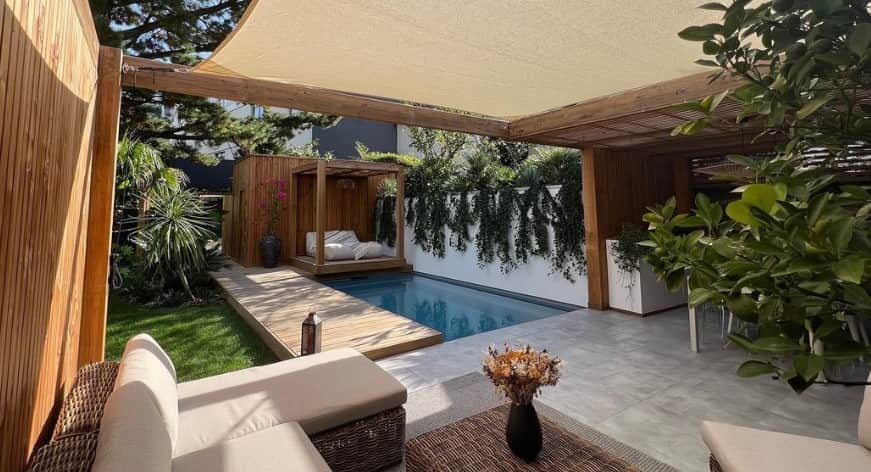
How to choose the right shade sail?
One of the most common mistakes when purchasing a shade sail is not thinking through the project itself beforehand. Before buying an outdoor sail, you need to carefully consider the layout you want to create. To do this, you need to keep your eyes open and fully understand your needs and your terrace, know its dimensions and identify possible attachment points in advance. Taking into account the sun's path and the orientation of your outdoor space are also criteria that will ensure a successful outcome.
Based on these factors, you can assess the type of fabric, the size and shape of the sail to choose, the location of its attachment points and the type of shade sail fastening (mat for stretched fabric,wall fastening, etc.). Here are a few criteria to consider for a successful installation.
The fabric of the solar sail
When it comes to fabric, you need to pay attention to the quality and material of the shade sail. You need to consider:
- your region: if it is windy, opt for an openwork shade that allows air and water to pass through, considering adding a roller option if you are very exposed to the wind (raised terraces, wind corridors, regions with mistral and tramontane winds, etc.). This way, you will have nothing to worry about once the shade sail is rolled up.
- your future location and the available height: if you want to choose a waterproof shade sail, you will need to create a 25% slope (25 cm difference in height per metre) and therefore have enough height for your attachment points. In addition, a waterproof shade sail will be more susceptible to wind.
- The weight of the fabric, i.e. the weight per square metre. This is a way of checking the quality and durability of the fabric. We recommend fabrics with a weight of 200g/m² or more to ensure effective sun protection. For example, we offer standard openwork shades at 220g/m² (lifespan of 3 to 5 years) and custom-made shades at 340g/m² (lifespan of 7 to 10 years).
Find even more advice on choosing the right material in our FAQ on which material to use for stretched fabric.
The size of the patio sail
When it comes to size, you may encounter a significant problem (no pun intended). This is the case with standard sizes: many people associate the size of their terrace with the size of the canvas. For example, if the terrace measures 4x5m, you might think that a 4x5m terrace canvas is the perfect option. But... in reality, this is not the case! In addition to the size of the sail itself, you must keep in mind that a canvas must be well stretched in order to look good and last a long time.
And to achieve this shade, you need to allow for tension distances (or setbacks) of around 45 cm at each corner to ensure the garden sail is properly tensioned (otherwise you will end up with a sail that is too large and flaps in the wind). Conversely, you may inadvertently choose a garden sail that is too small and does not provide sufficient coverage.
Find even more advice on choosing the right size in our other FAQ.
The colour of the solar fabric
Finally, the choice of colour is a decisive factor when making a purchase. At Espace Ombrage, we are renowned for our high-quality products, but also for our wide range of outdoor shade sail colours, which allow us to meet the different desires and styles of our customers' outdoor spaces. That's why it's important to choose a colour that will complement your outdoor space, to avoid ending up with a shade that doesn't go well with your patio. To help you make the right choice, we provide colour samples so you can be sure of your choice before you buy.
Pro tip: The darker the colour of the fabric, the cooler it will be underneath! Dark colours reduce the effect of the sun's reflection on your patio floor or windows, giving you a greater feeling of coolness.
Find even more advice on choosing colours in our other FAQ.
How to properly install your outdoor canvas?
The planning, location, fabric, size and colour are all set, well done! You've checked everything beforehand and the shade sail is now ready to be installed. Here are our tips to help you avoid the most common mistakes. We explain how to install your shade sail correctly so that it is taut and durable.
When you receive your shade sail, installation is a breeze as long as you follow these steps!
1. Lay your sail on the ground, seam side down and properly spread out so that you can see its entire surface. One mistake that seems insignificant but often happens is simply putting the sail on upside down!
When using an openwork shade sail fabric (such as Australe) and you have a right-angled triangle or a rectangle/square, this will not cause any problems during installation. However, if you have a particular shape with uneven dimensions or a waterproof shade sail (such as Acryl), this is where the mistake will become apparent. You will find that the pieces of the puzzle do not fit together and this may even cause water retention problems (as the seams of waterproof fabrics may store water if the shade sail is installed upside down).
2. Locate your corners: corner A is at the label with the barcode, then corners B and C follow clockwise. If you haven't made the previous mistake, then you won't make any mistakes at this stage (unless you read the time backwards!).
3. Identify the fixing points: you can use the ropes provided to model the tension axes of the sail (diagonals for quadrilaterals and medians for triangles). The fabric must be stretched along these axes. It is therefore important that the shade sail stakes and/or wall fixings are in line with these straight lines. Finally, this is when you mark the recesses to be applied (minimum 45 cm at each corner). Using this technique, you will know how to position the sail and where to create your attachment points.
4. Prepare your tensioning systems (preferably rope and pulleys, such as those we offer in our shop) so that you can easily tension your fabric. Be sure to choose the right tensioning system, otherwise you will not be able to easily attach or tension the garden shade sail. It is even riskier to decide not to use any tensioning system (i.e. to attach the sail directly to the ring) because after a while, the sail will slacken (like any fabric) and you will not be able to re-tension it (because you have nothing to do so with...).
Good to know:
- For entry-level sails such as Australe 220 or Solar 200, you need standard long tensioning systems.
- For higher-end sails such as Australe 340 or Acryl 300, you need reinforced long tensioning systems.
5. Then, using the carabiners and shackles, place your tensioners at the corners of your sail. Find the instructions for installing tensioning systems here. Tip: place your carabiner on the corner of the sail and the shackle on the wall or post so that you can quickly remove your sail in strong winds.
6. Next, attach the other end of your tensioning system to the wall or post.
7. Adjust the tension of the shade sail by pulling on the rope and then lock it in place using the cleat pulley. The sail should be completely flat. You can then adjust your terrace awning without a stepladder by tightening and loosening the ropes locked in the cleats on the pulleys on the mast or façade side.
In this video, we show you the different steps involved in installing a shade sail. We explain:
- the equipment needed to install the sail
- how to locate your shade sail attachment points
- how to drill holes to secure your stretched sail
- how to install the adjustable shade sail pole
- then how to hang and stretch the sail
Our team is available by email at contact@espace-ombrage.com or by telephone on +33 3 62 27 60 60 to answer your questions and assist you with your project.